
1. Overview
Railway Traces (Tracce) are the technical building blocks for rail transport planning. While a Service is a commercial product, a Trace represents the physical “slot” on the rail infrastructure, including its schedule, carrier, and technical limits.2. Technical Field Mapping
List View (Gestione Tracce)
The list view identifies available paths and their primary technical stakeholders.Technical Configuration (Form)
The configuration defines the physical feasibility of the movement.3. Key Stakeholders & Roles
To understand how a Trace works, distinguish between the two primary entities responsible for the journey:I. Vettore Ferroviario (Railway Carrier)
- Role: The “Traction Provider”. They own the locomotives and employ the drivers.
- Analogy: Think of them as the Trucking Company. They are the ones actually dragging the cargo.
- Examples: Mercitalia, Rail Cargo Austria, Captrain.
II. Gestore Infrastruttura (Infrastructure Manager)
- Role: The “Network Owner”. They own the physical tracks, the signaling systems, and the electric lines. They grant the “Permission to pass” (the Trace).
- Analogy: Think of them as the Highway Department. They provide the road upon which the carrier drives.
- Examples: RFI (Italy), ÖBB-Infrastruktur (Austria), DB Netz (Germany).
4. Data Lineage & Persistence
To ensure system-wide integrity, these fields are not free-text; they are linked to verified master data.
Technical Note: These collections are hosted on the AI Loop Database. When a user selects a value in the form, the system stores the unique ID of the record from the source collection into the destination MAGEMO_TRACES_LIST collection.
5. Form Interface
The following interface is used for the creation and maintenance of railway traces, capturing technical constraints and circulation frequency.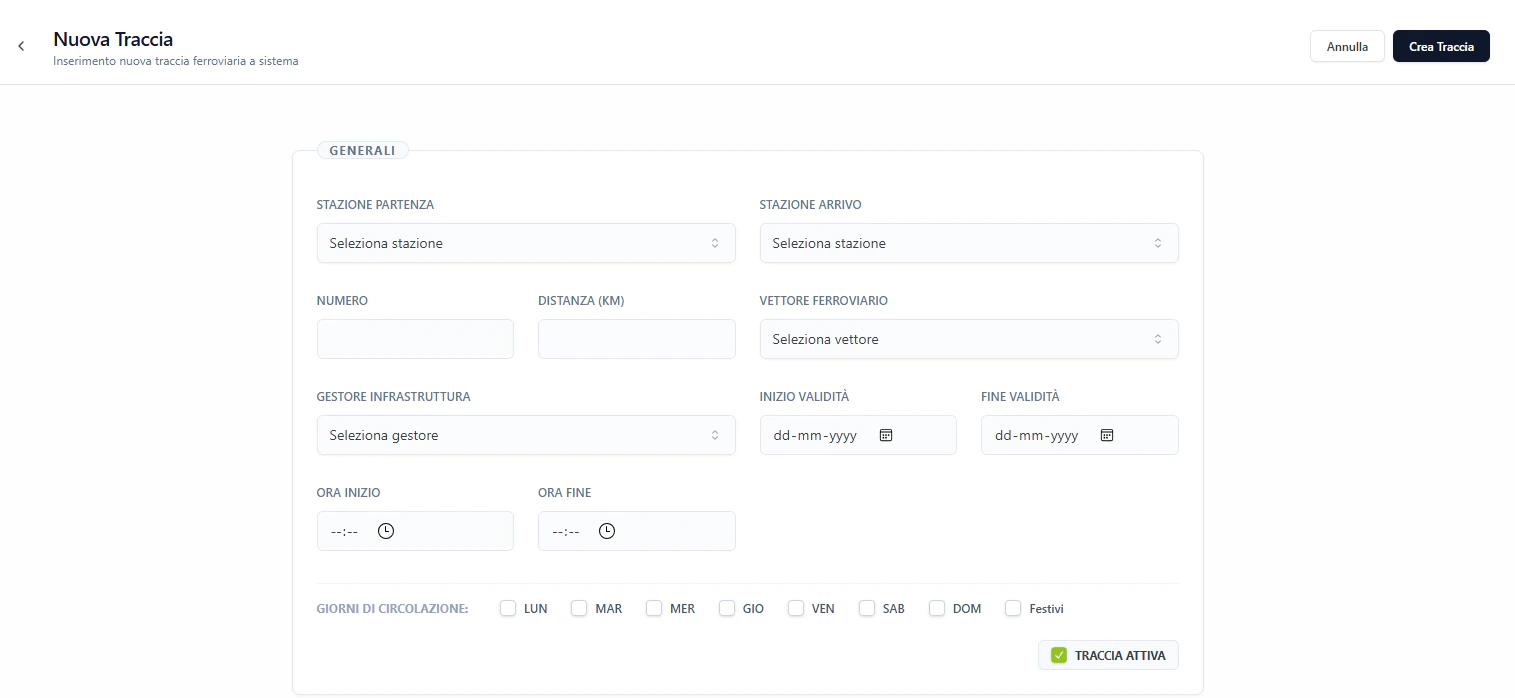
Interface for creating a new railway trace (Nuova Traccia).
3. Operational Logic & Maneuver (Section M53)
Railway Traces are more than just schedules; they are the technical constraints that define the capacity of the rail network.I. The Capacity Guardrail
The fieldspeso_max and lunghezza_max are physically enforced in the Planning > Rail module.
- Length Check: As wagons are added to the consist, the system sums their technical lengths (
anagrafica_carri.lunghezza_fuori_tutto). If the total exceeds the trace limit, the train is flagged as “Out of Gauge”. - Weight Check: The cumulative gross weight of wagons and loaded UTIs is checked against the trace’s
peso_max.
II. M53 Handover Logic
The system tracks precise shunting and maneuver timestamps required for train preparation. This is captured in the M53 Partenza and M53 Arrivo sections:- Preparation Phases: Four distinct time slots per station to capture complex preparation (e.g., terminal-to-shunting-yard).
- Operational Ready (OR): The timestamp when the train is technically ready for the Infrastructure Manager (IM).
4. Connectivity & Propagation
Inbound Dependencies
- Nodes Master: Traces perform lookups against Nodes filtered by type ‘Railway Station/Terminal’.
- Subjects Registry: Only subjects tagged with the role Vettore Ferroviario can be assigned to a trace.
Downstream Impact
- CIM Generation: The
numero(Train Number) is a mandatory field in the Rail Consignment Note generated in Execution. - PCS Handshake: Technical integration with Port Systems uses the trace’s train number as the unique “Arrival/Departure Identifier” for EDI synchronization.