
1. Overview
Management and Automation of Requests for Quotation (RFQ) streamlines the procurement lifecycle by automating the response generation process. This deliverable addresses the need to “automate the RFQ process based on specific needs, allowing for a quick and accurate response from suppliers and improving overall efficiency.” By reducing manual intervention in the quotation process, the system significantly decreases the time it takes to issue quotes and offers.2. Scope and Business Meaning
Functionally, this deliverable covers the Automated Procurement Execution layer. It ensures:- Process Automation: Triggering RFQ processing capabilities electronically to eliminate manual delays.
- Precision Response: Generating responses that strictly adhere to the specific “Service Request Details” defined by the customer.
- Efficiency Gains: Minimizing the turnaround time between a request and a calculated offer.
3. Implemented Functionalities
The platform implements “Management and Automation of RFQ” through the Quotation Execution Engine, which processes defined requests into calculated quotes.Automated RFQ Processing
Requirement Addressed: “Automate the RFQ process” The system utilizes an automated execution flow to process requests:- One-Click Execution: The “Run” capability triggers the automated analysis of the Quote ID.
- Instant Calculation: The system automatically computes costs and feasibility based on the input parameters relative to supplier contracts.
- Status Automation: Automatically transitions requests from “Received” to “Cost Calculated” without manual data entry. Refer: Quotation Management
Needs-Based Customization
Requirement Addressed: “Based on specific needs” The automation engine is driven by precise customer specifications captured in the RFQ:- Specific Service Parameters: Automates logistics based on exact needs like “terminal-to-terminal”, “Round Trip: No”, and “One-off” frequency.
- Cargo-Specific Logic: Adapts the automated response to cargo details such as “Bulk: true”, “Intermodal Units: false”, and specific codes (NHM).
- Route-Specific Execution: Processes unique route combinations (e.g., Beihai Tieshangang to CONCOR CFS Milavittan) individually.
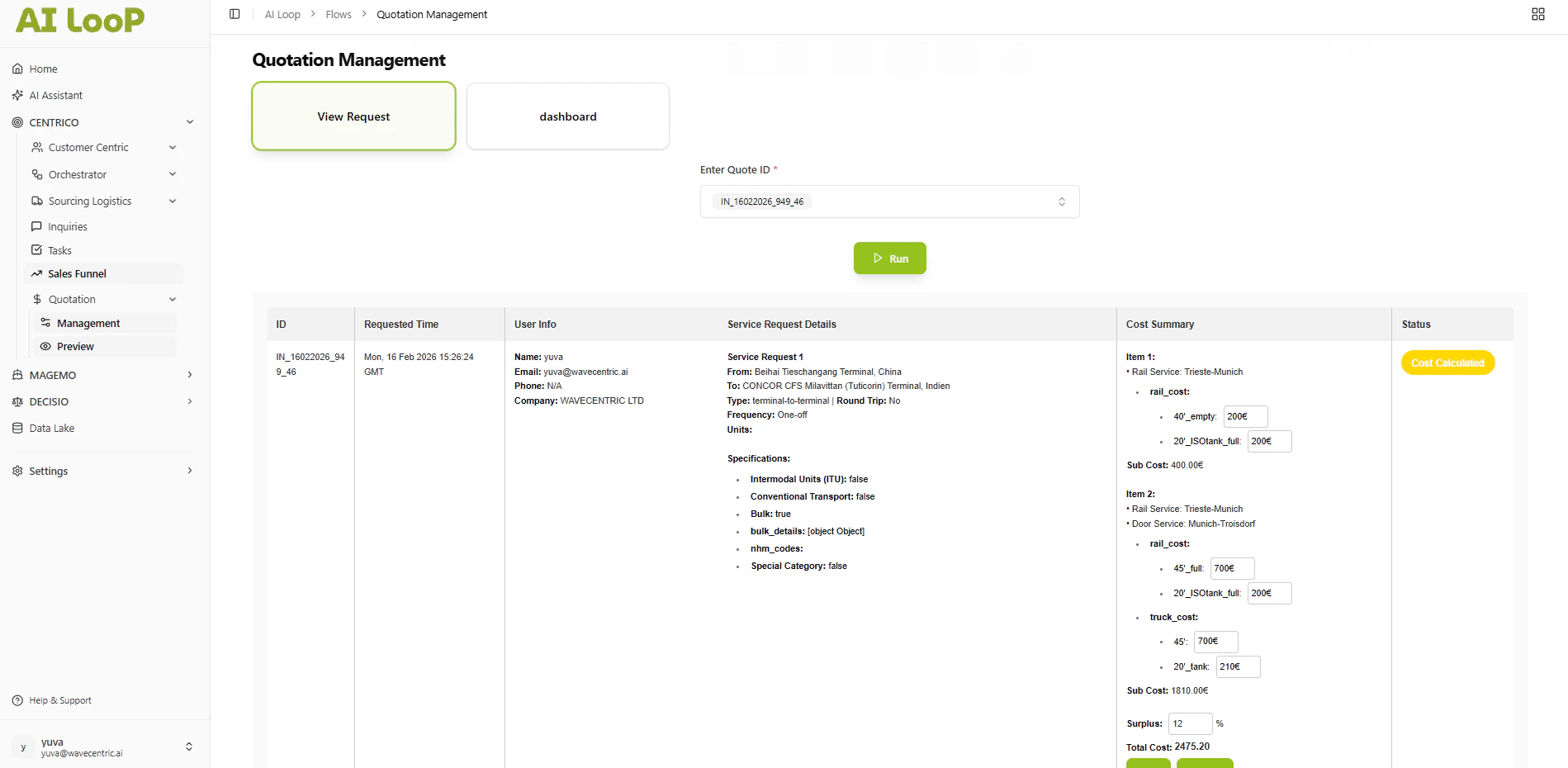
The Quotation Management interface where specific needs are defined and the automated RFQ process is triggered.
Efficiency & speed
Requirement Addressed: “Quick and accurate response… improving overall efficiency” The platform optimizes for speed:- Immediate Costing: Instantly generates line-item costs (Rail Service, ISOtank, Trucking) upon execution.
- Surplus Calculation: Automatically applies margin logic (e.g., 12% Surplus) to ensure commercial viability is assessed instantly.
- Reduced Cycle Time: Eliminates the wait time associated with manual supplier inquiries by digitizing the offering logic.
4. Technical Enablement
The platform enables this deliverable through:Execution Engine
- Flow Command: The
quotation-managementflow includes a specificRuncommand that initiates the automation sequence. - Pricing Algorithms: Backend logic that takes specific “Service Request Details” as input variables and outputs precise cost structures.
- Data Binding: Links specific RFQ parameters (Units, Specifications) directly to the pricing engine.
User Interface
- Run Control: A dedicated execution button for triggering the RFQ automation.
- Detail Visualization: Clear display of the input parameters (User Info, Request Details) alongside the automated output (Cost Summary).