
1. Overview
Calculation of Approach Costs and Economic Optimization empowers procurement teams with analytical tools to evaluate and optimize logistics expenses. This deliverable addresses the need to “analyze the costs related to the various logistics options and provide suggestions to reduce costs, improving the economic optimization of operations.” By providing transparent cost breakdowns and comparative analysis capabilities, the system enables achieving the best cost-benefit ratio in procurement operations.2. Scope and Business Meaning
Functionally, this deliverable covers the Cost Analysis & Economic Optimization layer. It ensures:- Transparent Cost Calculation: Detailed breakdown of all cost components for informed decision-making.
- Comparative Analysis: Ability to evaluate multiple logistics options side-by-side.
- Optimization Insights: Data-driven identification of cost-reduction opportunities.
3. Implemented Functionalities
The platform implements “Calculation of Approach Costs and Economic Optimization” through the Cost Summary Engine with integrated margin analysis and optimization tools.Detailed Cost Breakdown
Requirement Addressed: “Analyze the costs related to the various logistics options” The system provides comprehensive cost visibility:- Service-Level Costing: Itemized costs for each service component (Rail Service, Door Service, etc.).
- Sub-Component Analysis: Detailed breakdown of individual cost elements within each service (container types, routes, handling).
- Total Cost Aggregation: Automatic calculation of total costs including all service components.
- Editable Parameters: Ability to adjust individual cost elements to explore optimization scenarios. Refer: Quotation Management
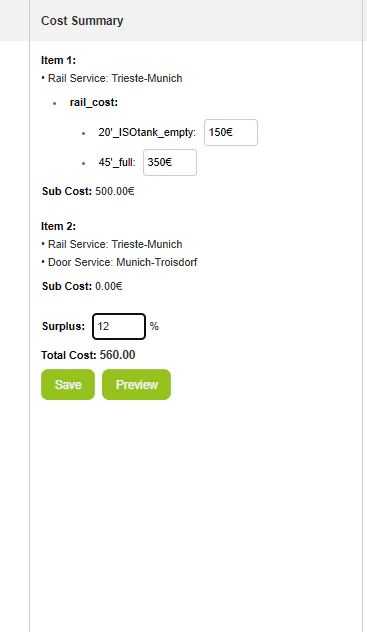
The Cost Summary interface providing detailed breakdown of logistics costs for analysis and optimization.
Economic Optimization Analysis
Requirement Addressed: “Provide suggestions to reduce costs, improving the economic optimization” The platform enables cost optimization through:- Margin Intelligence: Clear visibility of surplus/margin percentages enabling profitability analysis.
- What-If Scenarios: Editable cost fields allow testing different pricing structures and supplier options.
- Cost Comparison: Ability to analyze multiple quotes to identify the most cost-effective logistics approach.
- Real-Time Recalculation: Instant total cost updates when adjusting individual components, supporting rapid optimization decisions.
Best Cost-Benefit Ratio
Requirement Addressed: “Important for achieving the best cost-benefit ratio in procurement operations” The system supports optimal procurement decisions:- Transparent Pricing: Complete visibility into all cost elements ensuring no hidden charges affect decision-making.
- Service-Cost Alignment: Link specific services to their costs, enabling evaluation of value delivered vs. expense incurred.
- Optimization Controls: Save and Preview functions allow comparing optimized scenarios before finalizing.
- Historical Benchmarking: Access to past quotation costs supports trend analysis and continuous optimization.
4. Technical Enablement
The platform enables this deliverable through:Cost Calculation Engine
- Pricing Algorithms: Backend logic calculating total costs from individual service components and parameters.
- Dynamic Recalculation: Real-time cost updates as users modify individual elements in the interface.
- Margin Application: Automatic surplus/margin calculation based on configurable business rules.
Optimization Interface
- Editable Fields: User-modifiable cost inputs for scenario testing and optimization exploration.
- Summary Views: Consolidated cost presentation enabling quick comparison across options.
- Save/Preview Functions: Workflow controls for iterating on cost optimizations before committing.