
1. Overview
Real-Time Analysis of Customer Requirements Specifications is the intelligent orchestration layer that transforms raw customer requests into optimized logistics plans. It fulfills the requirement to “analyze customer requests in real time, evaluating parameters such as volumes, weight, destination, in order to optimize transport routes and delivery times.”2. Scope and Business Meaning
Functionally, this deliverable covers the Operational Intelligence & Optimization layer. It ensures:- Instant Evaluation: Immediate assessment of complex logistics variables (Volume, Weight, Destination) at the point of inquiry.
- Route Optimization: Algorithmic selection of the most efficient transport paths based on live constraints.
- Time Efficiency: Drastic reduction in query-to-quote time by automating the feasibility analysis.
3. Implemented Functionalities
The platform implements “Real-Time Analysis” through the New Inquiry Wizard and Route Scanner, which structure the analysis into four distinct phases of optimization.Step 1: Geospatial Route Analysis
Requirement Addressed: “Evaluating parameters such as… destination” The system performs instant geospatial analysis to identify the primary transit points:- Origin & Destination: Precise location identification for both pickup and final delivery to determine feasibility.
- Visual Mapping: Real-time geospatial visualization of the selected logistics path to verify the route corridor. Refer: Data Lake Manager
Step 2: Multi-Modal Route Optimization
Requirement Addressed: “Optimize transport routes and delivery times” The system evaluates available paths across Rail, Road, Sea to generate the optimal logistics chains:- Multi-Modal Analysis: Comparative analysis of different transport modes to identify the best balance of cost and speed.
- Route Summary: Detailed metrics on distance and transport legs for each calculated path.
- Transit Time Estimation: Real-time calculation of expected delivery times (ETA).
Step 3: Service & Constraints Definition
Requirement Addressed: “Analysis of Customer Requirements” The analysis extends to the specific operational parameters requested:- Service Categories: Evaluation of Door-to-Door, Door-to-Terminal, and Terminal-to-Door requirements.
- Terminal Handling: Identification of specific handling needs at origin or destination hubs.
Step 4: Quantitative Parameter Evaluation
Requirement Addressed: “Evaluating parameters such as volumes, weight” The system validates the physical specifics of the cargo against transport limitations:- Loading Unit Specification: Analysis of intermodal units including type, size, quantity, and weight.
- Cargo Specifications: Validation of specialized data such as NHM Codes, Dangerous Goods (ADR/UN), or Waste (CER).
- Handling Constraints: Verification of constraints like Craneability or specific temperature requirements.
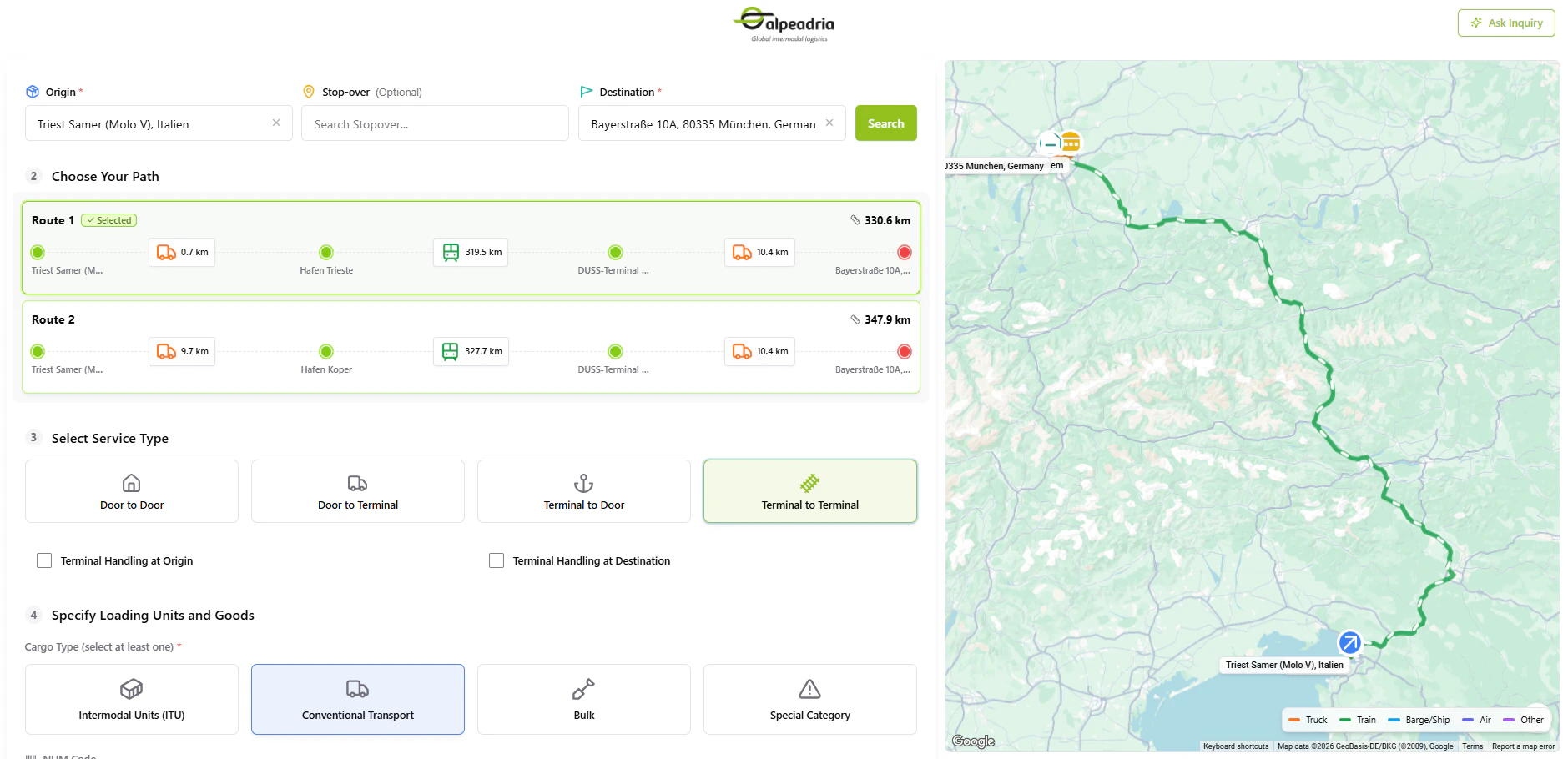
The Route Optimization interface displaying real-time analysis of transport paths.
4. Technical Enablement
The platform enables this deliverable through:Operational Analysis Engine
- Route Scanner Service: A dedicated microservice that ingests inquiry parameters (weight, volume, origin, destination) and computes optimal logistics chains in milliseconds.
- Constraint Solver: Validates the feasibility of each route against the physical properties of the cargo (e.g., “Cannot put 30 tons in a standard container”).